
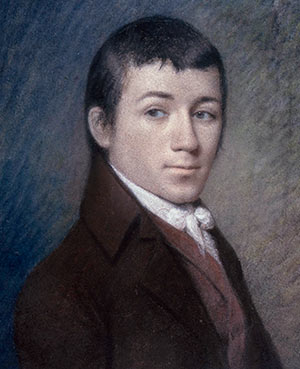
With the upcoming release of the final volume of The Collected Writings of Charles Brockden Brown, Bucknell University Press celebrates the completion of this robust and comprehensive series. Edited by Mark L. Kamrath and Philip Barnard, the multivolume series traces the underresearched textual contributions of Charles Brockden Brown (1771-1810), whose letters, poems, essays, reviews, historical narratives, and pamphlets with rich political and philosophical insight. As a trained lawyer and one of the first authors of the American short story, Brockden Brown helped shape the American literary landscape with his prolific knowledge and astute theories.
Expanding the Bicentennial Edition of The Novels and Related Works, (edited by Sydney J. Krause and S.W. Reid), which traces Brown’s six novels, the Collected Writings opens the archive and recontextualizes Brown’s impact and influence on the young American republic. The seven-volume series not only draws attention to Brown’s extensive literary contributions but also highlights the political and social controversies and contradictions of the country’s founding. With detailed annotations, the Collected Writings offers new insights into the figure’s mind and provides a capacity to understand the historical time period in which he lived and wrote.
BUP’s Cynthia Fell Intern, Maddy Grieco ’26, spoke with Kamrath and Barnard about their experience stewarding the series, gaining insight into the editorial process behind the Collected Writings, and discovering more about Charles Brockden Brown’s contributions to postrevolutionary America.
BUP: Where did the idea for this project originate, and why did you choose Charles Brockden Brown?
Kamrath & Barnard: When we embarked on this long-term project in the early 2000s, we were early and mid-career scholars who shared a strong interest in Brown (“CBB,” as we know him). In the subfield of early American literary studies, interest in Brown had been growing steadily since the 1970s. In the 1970s-90s, Brown was known and studied almost exclusively as a novelist, and an important wave of new scholarship had followed the publication of a six-volume edition of Brown’s novels and related writings (i.e. other long fictions) by Kent State University Press. Brown was clearly an important and complex figure, perceived as a major writer that no serious account of US literary and cultural history could ignore. Yet, at that point, he was also relatively understudied by comparison to other major or canonical US writers before the Civil War, and often reduced to a few reductive commonplaces that gave the impression that Brown was little more than a moody “gothic” writer of thrilling romances and a “flawed” artist in aesthetic terms.
Along with others in the field, we were founding members of a new Charles Brockden Brown Society in 1998-2000, and, to counter these prevailing commonplaces, along with colleague Stephen Shapiro (Warwick University, UK), we started to work together by proposing, editing, and contributing chapters to a 2004 essay collection, Revising Charles Brockden Brown: Politics, Culture, and Sexuality in the Early Republic.
At this juncture, in the early 2000s, one of the collective interests of the newly founded Brown society was a focus on updating and advancing the long-term work of German and US scholars (notably Alfred Weber, Wolfgang Schäfer, and Fritz Fleischmann) in bringing Brown’s non-novelistic writings to light. Brown was an extremely prolific and erudite writer: besides the seven novels for which he is known and which are commonly taught in university classes, he edited three magazines filled with his own tales, essays, reviews, political, cultural, and scientific commentary, and historical narratives. Other writings include separate political pamphlets, poetry, and a wide correspondence, of which almost 200 letters survive today. These texts are all of great importance in understanding US culture and the cultural politics of the early republic, the period from independence to the 1820s. Our strong perception, therefore, was that making these texts available in a properly edited and organized form should be part of the next major stage in Brown scholarship.
BUP: What was your process for researching, annotating, and editing Brown’s
previously uncollected writings?
Kamrath & Barnard: Our process, which has taken almost twenty years, had three main phases. The project began with a massive, multi-year, bibliographical effort to establish a reliable and comprehensive bibliography and electronic database of all known writings by CBB. To make a long story short, with the help of grants from the NEH and other sources, we developed a searchable archive of CBB’s entire corpus, coded in TEI. We were able to cross-check texts with current early-modern databases and thereby eliminate a great many items that had been erroneously attributed to CBB before the digital era. Likewise, research for the project turned up a handful of new texts that can be reliably attributed to CBB, all of which resulted in a far more reliable and comprehensive bibliography and corpus than was available to earlier scholarly generations.
Second, we turned to the large task of a print edition. We contracted for the series with Bucknell University Press, developed a division or organization of this enormous body of material into seven volumes, and produced a set of editorial protocols and guidelines in keeping with MLA CSE (Modern Language Association Committee on Scholarly Editions) standards for modern scholarly editing. With colleagues drawn largely from the Brown Society, we recruited editorial teams, who then used the project’s database to develop their respective volumes.
Finally, over the last thirteen years, since the first volume appeared in 2013, we have worked with each volume’s editorial team to finalize their work, see it through the MLA-CSE vetting process, and on to the final publication stage.
BUP: Did your archival research present any particularly surprising or unexpected insights about Brown’s life or his theoretical views?
Kamrath & Barnard: A great many! In terms of Brown’s life and general thinking, our work on the letters unearthed a great deal of new information, and clarified many questions about his professional,personal, and family relations.
In conceptual terms, Brown’s consistent advocacy for women’s rights and opposition to slavery becomes clearer with this edition. His heated 1795 exchange about religion, in letters with his close friend Joseph Bringhurst, Jr., is important in clarifying Brown’s early and consistent skepticism and anti-theism. Importantly, these volumes, for example with texts like the late “historical sketches,” a large and unfinished historical fiction project from 1805-06, put paid to long-standing commonplaces according to which the later Brown, after 1801, somehow became “conservative” or abandoned his Godwinian-Wollstonecraftian perspectives, which were the most “progressive” ideological-intellectual positions in anglophone literary culture of the 1790s. That Brown remained consistent in his ideological orientation throughout this career is, in itself, a basic conclusion to be drawn from the edition.
Important dimensions of Brown’s writing that have previously remained little known or unknown are brought to light in these volumes. Volume 1 publishes all of Brown’s known correspondence for the first time. Volumes 2 and 3, featuring writings from the monthly magazine and literary magazine, establish important new findings about CBB’s editorial methods and which texts CBB authored in those periodicals, not to mention previously unknown texts. Volume 4, Political Pamphlets, establishes new knowledge concerning Brown’s output in this genre, presents the first consequential analysis of the pamphlets’ relations to their contexts, and delimits the corpus by definitively eliminating from consideration one pamphlet that was long considered to be Brown’s work. Volume 5, Historical Sketches and Fragments, makes available the entirety of this important work for the first time anywhere; previously, it was available only in separated and editorially problematic fragments in archival sources. Volume 6, The American Register and Other Writings, makes available for the first time Brown’s major achievement in historical writing, the “Annals of Europe and America.” Volume 7 brings to light an almost completely unknown dimension of his corpus, over fifty poems previously scattered in manuscript and periodical sources, including several newly discovered items, and makes it clear that Brown was an exceptionally knowledgeable reader, practitioner, and student of his era’s poetic traditions.
BUP: What do you hope the volumes reveal about Brown’s cultural contributions beyond his literary activity?
Kamrath & Barnard: Overall, we hope the full extent and range of the seven volumes, considered together, underlines and documents the depth, coherence, and consistency of Brown’s intellectual and literary project and achievement. Our greatest ambition would be for this set to help push work on Brown forward and cement a new and better understanding of his significance, not only as an important novelist (or romancer, as he would have put it), but as a major voice of the revolutionary period and late Enlightenment.
Since you add the phrase, “beyond his literary activity,” we must observe that, in Brown’s lifetime and culture, the word and category “literary” or “literature” applied to all of print culture, whether that concerned science, religion, politics, history, or other areas, and was by no means restricted to the more recent sense of belletristic writing and genres like the novel, poetry, drama, and so on. Thus, we hope this edition makes it clear that Brown was, in fact, a prodigious writer in a wide range of genres and an acute commentator on many of the large questions of his day. We feel that, among anglophone writers, he should rightly be considered alongside figures like Poe and Melville in the United States, or Godwin and Shelley (either Shelley!) in Great Britain.
BUP: How can the Brocken Brown volumes be used and studied in classrooms today?
Kamrath & Barnard:
The set provides students and scholars with a far more complete corpus of Brown’s writings, and thus with access to a larger, more comprehensive arc of this thinking and writing.
To take just one example, one might have students read Brown’s novel Edgar Huntly (1799), and ask them to compare and contrast that sensational fiction about settler colonialism with this 1803 pamphlets on the Louisiana Purchase, or his discussion of the Aaron Burr Conspiracy in the 1807-09 “Annals of America.” All these texts consider how colonial or imperial ambitions shaped the Americas. Likewise, students can use the project’s electronic archive to search for additional relevant texts, like periodical essays or Brown’s 1804 translation of C.-F. Volney’s A View of the Soil and Climate of the United States, where he comments in his notes on the ongoing displacement of Native Americans.
BUP: Is there anything else you would like to share with the readers?
Kamrath & Barnard: Read Brown! He has a bright and expansive critical and cultural future ahead of him: two feature-length films based on his fictions have appeared in the past decade, and more will come. He seems a writer custom-made for our troubled times. Particularly in this era of US political upheaval, extreme partisanship, and imperial decline, as well as rapidly shifting global or world-systemic relations on all levels, Brown is more relevant than ever to a critical understanding of the cultural and ideological history of the US nation-state and the revolutionary period generally.
About the series editors
PHILIP BARNARD is a professor emeritus of English at the University of Kansas.
MARK L. KAMRATH is a professor of English and codirector of the Center for Humanities and Digital Research at the University of Central Florida.
All volumes are available in paperback, cloth, and ebook formats from Bloomsbury.
Volume 1: Letters and Early Epistolary Writings
Edited by Philip Barnard, Elizabeth Hewitt, and Mark L. Kamrath
Volume 1 traces Brown’s correspondence and epistolary fiction (in fragments). His correspondence covers 179 letters to notable figures, including Thomas Jefferson and Albert Gallatin.
Volume 2: The Monthly Magazine and Other Writings, 1789-1800
Edited by Matthew Pethers, Leonard Von Morzé, and Hilary Emmett
Volume 2 contains Brown’s writings, stories, and essays featured in The Monthly Magazine, a publication he edited from 1799 and 1800. This volume also includes his contributions to The Columbian Magazine and The Weekly Magazine.
Volume 3: The Literary Magazine and Other Writings, 1801-1807
Edited by Robert Battistini, Michael A. Cody, and Karen A. Weyler
Volume 3 focuses on Brown’s published writings from 1801 to 1807 that were featured in The Literary Magazine and American Register. Nonfiction essays also appear in this volume, including his review essays, articles, and biographical sketches.
Volume 4:Political Pamphlets
Edited by Mark L. Kamrath, Stephen Shapiro, and Maureen Tuthill
Volume 4 analyzes Brown’s political pamphlets, including those that discuss the Louisiana Question and Jefferson’s Embargo.
Volume 5: Historical Sketches and Fragments
Edited by Philip Barnard and Yvette South
Volume 5 shares the entirety of Brown’s Historical Sketches and Fragments in a cohesive and unified whole.
Volume 6: The American Register and Other Writings, 1807-1810
Edited by Jared Gardner and Elizabeth Hewitt
Volume 6 highlights Brown’s later writings, many of which are from his periodical project, the American Register. The volume also contains the full version of “Annals of Europe and America.”
Volume 7: Poems
Edited by Michael Cohen and Alexandra Socarides
Volume 7 collects and brings together Brown’s uncollected poems.