Impolite Periodicals: Reading for Rudeness in the Eighteenth Century is the newest title in Bucknell University Press’ Transits: Literature, Thought & Culture, 1650-1850 series, following Kathleen Tamayo Alves’ debut, Body Language: Medicine and the Eighteenth-Century Comic Novel (2025). BUP’s Transits series publishes monographs and edited volumes that are timely, transformative, and global in their engagement with arts, literature, culture, and history.
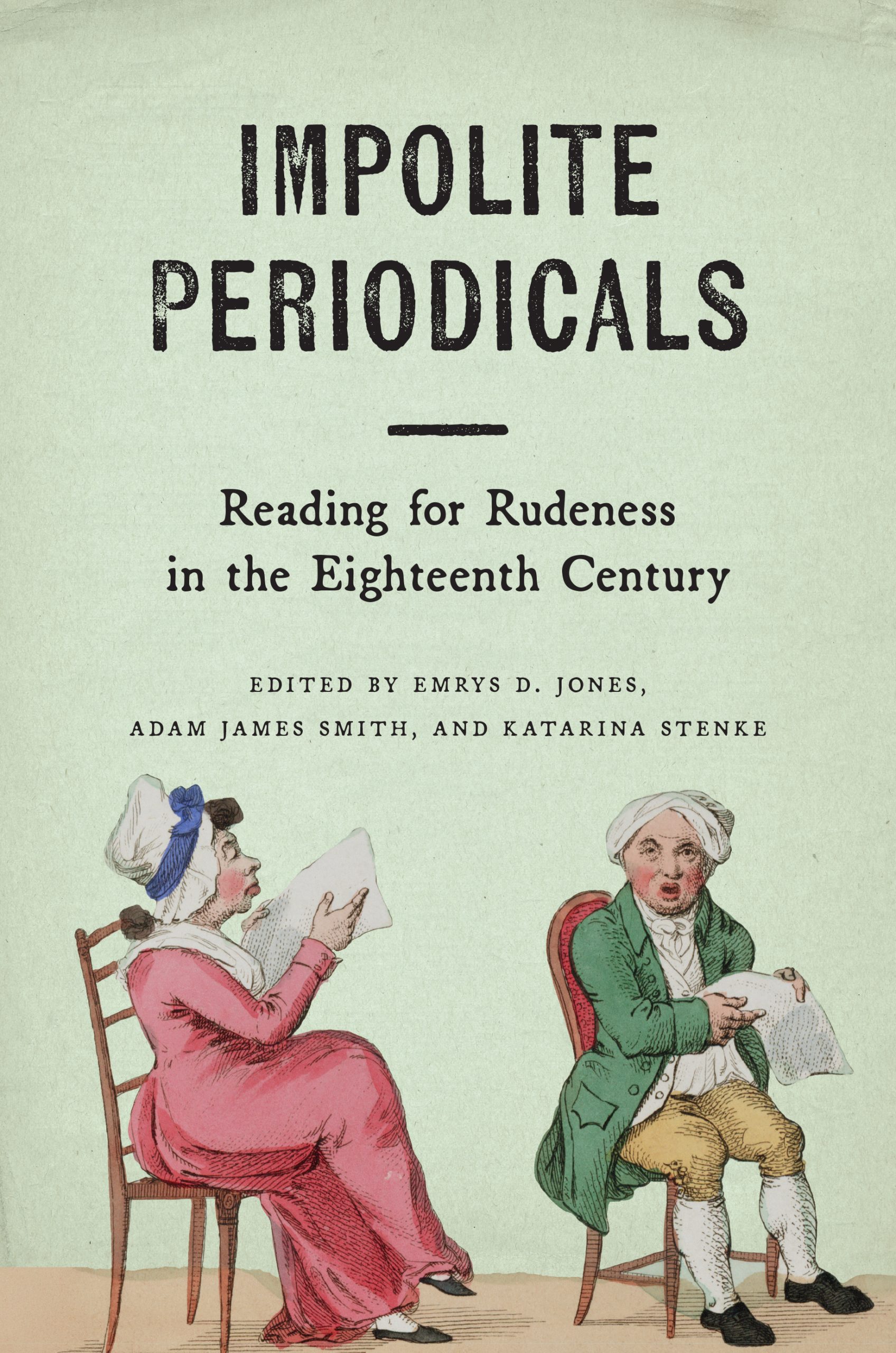
Impolite Periodicals, edited by Emrys D. Jones, Adam James Smith, and Katarina Stenke, “reads for impoliteness, revealing a more nuanced, granular, and dynamic view of eighteenth-century periodicals.” With an emphasis on The Spectator and The Tatler, Impolite Periodicals “promotes a new history of the periodical characterized not as highbrow gatekeeper of literary taste, but as incongruent, idiosyncratic, and impolite. This collection thus brings together a range of perspectives on eighteenth-century periodical publication, not simply to argue that periodicals could be impolite, but to explore how readings of their potential impoliteness might affect our understanding of their literary and social significance.”
In this blog post, Jones, Smith, and Stenke discuss both their individual contributions and the collection as a whole, what it means to “read for rudeness” in eighteenth-century literature, and how we could all benefit from reading against the political grain.
Bucknell University Press: Impolite Periodicals focuses on the roles of rudeness, inconsistency, impurity, and failure in how eighteenth-century society functioned. How did this vein of research begin for each of you?
Adam James Smith: The subject of Impolite Periodicals actually weaves together several strands of research that have animated my work since my PhD. My doctoral project focused on Joseph Addison’s Whig-sponsored periodical writing, particularly his work on The Free-Holder (1715-16), and was especially concerned with the question of whether (and how) we can separate partisanship, propaganda, and politeness. My postdoctoral work then turned to radical newspapers printed in Sheffield during the French Revolution, and the protest literature they published.
Since then, most of my work has focused on eighteenth-century satire and theories of satire more broadly, which similarly involve a careful navigation, and often deliberate disruption or subversion, of sociability, while simultaneously claiming some ambition to restore or reform it. In this sense, the Impolite Periodicals draws together questions that have been central to my research for over a decade.
Emrys D. Jones: Like Adam, I’ve been exploring these themes in some form or other since my PhD research and the book that came out of that. On the surface, the framing concepts for my research have always presented quite a congenial view of eighteenth-century British life: friendship, loyalty, sociability, clubbability. But even from the early days of my work in this area, I’ve been interested in how that idealistic eighteenth century is punctured and undermined, how hypocritical it could be, and who is excluded from it. My first monograph, Friendship and Allegiance in Eighteenth-Century Literature (2013) reflected a lot on the ways that friendship could be weaponized by writers of the period, which is a kind of rudeness in itself. It was natural to want to build on those observations by interrogating the reputation of eighteenth-century periodical literature as a vehicle for politeness and to demonstrate the major contradictions in that longstanding view.
Katarina Stenke: For me this question is probably a bit harder to answer than for Adam or Emrys, because at first glance I guess Impolite Periodicals seems relatively distant to my core research specialism in eighteenth-century poetry and poetics, and my journey to the project is a little more complicated. However, the ideas and arguments that we explore in the book reflect questions that have interested me throughout my research. Today, media genres, trends and conventions often appear, mutate, and subside extremely fast, especially online. Although operating in a less accelerated cultural sphere, eighteenth-century writers and readers experienced similar discursive transformations and instabilities, and my research examines how authors and readers of the period both shaped and were subjected to such change.
In poetry, that might involve asking how far classical genres like epic are adapted to accommodate new topics, events and meanings, for instance in James Thomson’s long poem The Seasons (1746), or how new voices—authors, narrators, characters—reorient the meanings and values of neoclassical poetics, as in the elegies composed by Phillis Wheatley Peters (c.1753-1784), the first African-born woman to publish a book of poetry in English. Above all, I’m fascinated by the relative “elasticity” of social and discursive codes, that is, how far norms of “polite” discourse can be stretched before they are deemed “impolite.” Developing, co-writing and editing Impolite Periodicals alongside Emrys, Adam, and all our fantastic contributors has been a great opportunity for me to consolidate my own thinking on the geo-politics of literary decorum, in particular with reference to Joseph Addison’s orientalist Spectator essays. It’s also involved an exciting deep dive into the world of eighteenth-century periodicals, revealing the dazzling rhetorical range and complexity of an often overlooked genre.
BUP: What kinds of conversations surrounding your own critical essays went into developing the collection as a whole?
Smith: It quickly became apparent as the chapter drafts came in that, as we had originally suspected, impoliteness was not an isolated phenomenon, but a recurring and structurally important feature of eighteenth-century print culture. Conversations with other contributors highlighted how writers across different political positions and periodical forms used impoliteness strategically: to provoke readers, to signal sincerity, or to challenge the authority of their opponents. This helped sharpen my own chapter, as I realised that what have first appeared to be a natural waning of polite principles, in the case of Richard Steele, was in fact a deliberate rhetorical shift. One of the most productive outcomes of this collaborative process of collating and editing this volume was the gradual recognition that in the eighteenth century impoliteness could function as a way of negotiating authority, allowing writers to present themselves as candid, principled, or oppositional within an increasingly contested public sphere.
Jones: I’ve been hugely grateful to Adam and Katarina for the conversations that have led to this volume, starting with a panel that we organized at 2019’s International Congress of the Enlightenment (in Edinburgh). For a project fundamentally concerned with impoliteness, I would like to think that we’ve always been quite polite towards each other and to our contributors! And that has included being open to different understandings of what impoliteness would mean for different essays in the book, likewise allowing a very broad definition of what we consider periodical literature to be. I think that Impolite Periodicals is stronger because of this. In particular, I was pleased to find a home for my own essay, given that the main sources I was examining are perhaps further from the literary canon than others and have sometimes been dismissed as not really belonging to the same periodical tradition as Addison and Steele’s works.
Stenke: One of the conversations we returned to many times was how the balance in the collection between “canonical” and “non-canonical” periodicals and authors was developing as contributions came in. On the one hand, it seemed absolutely crucial to widen the scope of our collection beyond the traditional authors—Joseph Addison and Richard Steele in particular—so as to reveal the vibrant multiplicity of periodical culture across the eighteenth century. For me this is a question I continue to ask as I develop new projects and try to balance diving into super-niche quirky corners of eighteenth-century literature with the equally appealing task of renewing and extending our knowledge of canonical authors and genres that have had a huge impact on how we think of ‘literature’ today.
BUP: You note that the nuance behind the word “impolite” is reliant on the period of time in which it was used. In the eighteenth century, “impolite” could refer to one’s behavior, but also their class and education. Further, the public opinion of one’s “impoliteness” was reliant on their race, gender, sexuality, and class. In what ways do these categories and their intersections shape the roles of rudeness and impurity in eighteenth-century literature?
Smith: In the eighteenth century, “impoliteness” was never just about manners, it was a way of classifying people socially and politically. Politeness was closely associated with education, refinement, and participation in elite culture, while “impoliteness” was often used to marginalise those seen as socially, culturally, or politically outside that sphere. This meant that judgements of politeness were deeply shaped by class, but also by sex and race. Women, for example, were held to particularly strict standards of polite behaviour, and accusations of impoliteness could be used to undermine their authority or credibility. Similarly, colonial and racial difference was frequently framed in terms of civility and refinement, reinforcing hierarchies between Britain and the peoples it sought to govern. Politeness functioned as a form of cultural power. It helped define who could speak with authority in public, and whose speech could be dismissed as irrational, excessive, or uncivil. Literature and periodicals were central to this process, because they did not simply reflect these categories, they actively produced and reinforced them.
Jones: Our contributors are really attentive to this slipperiness of impoliteness as a concept, the ways that it can pose as a neutral social ideal while being thoroughly implicated in class dynamics, the rampant misogyny of the era, and other political assumptions. Part of the goal of my own chapter is to think about why Lady Mary Wortley Montagu’s experiment in periodical writing, The Nonsense of Common-Sense, wasn’t a great commercial success. The answer might be that she’s too polite for her own good, but her politeness is more than an unwillingness to enter into bitter partisan argument—it’s also firmly rooted in her gender and her self-perception as an aristocrat. Across the book, our contributors show a wide range of ways that rudeness could be liberating for writers, but we’re also thinking about the limits of that liberation.
BUP: Who is your intended audience for Impolite Periodicals?
Smith: Impolite Periodicals is intended primarily for scholars and students of eighteenth-century literature, history, and print culture, as well as those interested in the history of political communication and the public sphere. The collection speaks to researchers working on periodicals, satire, and the cultural politics of politeness, but it also engages broader questions about how tone, civility, and credibility function in public debate. At the same time, it hopefully speaks to anyone interested in the history of political discourse, and in understanding how questions about civility, incivility, and public speech have long been central to literary and political culture.
Jones: The question of impoliteness can speak to our current moment with its anxieties about the basis of public discourse, specifically within news media. I think there’s value in establishing a candid historical narrative for rudeness’s value in public life, not because I want to see more politicians and celebrities being rude to each other, but because our old expectations of civility are woefully inadequate when it comes to accounting for the media landscape today or for the structural inequalities in our society.
BUP: What do you hope this collection will bring to eighteenth-century studies?
Smith: I hope the collection encourages scholars to rethink politeness not as a stable cultural ideal, but as something contested, strategic, and deeply political. It shows that rudeness, satire, confrontation, and even bad manners were not simply failures of polite culture, but could be powerful tools for political argument and public engagement.
More broadly, I hope the collection contributes to ongoing conversations about how literature participates in public life. Eighteenth-century periodicals were central to shaping political debate, and studying their use of politeness and impoliteness helps us better understand how authority, credibility, and public voice were constructed. These questions remain highly relevant today, particularly in discussions about civility, political rhetoric, and the boundaries of acceptable public speech.
Jones: I’ll say that I want to open up periodical literature, in all its guises, to literary analysis. Obviously, the last few decades have already seen much excellent work done in this area, not least by the author of our Afterword, Manushag Powell. But I think even now there can be a resistance to reading ostensibly ephemeral essays in the same way we read novels, poems, plays.
Stenke: I think that one of the strengths of this collection is that its combines literary-historical rigour with close attention to the rhetorical strategies of periodical prose; as the book demonstrates, periodical writers of the period had to negotiate competing claims and complex political landscapes, and their prose is often correspondingly agile and interesting, even when it’s not as “polished” as other kinds of writing.
Another thing that has struck me from when we first started receiving our contributors’ draft chapters is how lively, precise and engaging they all are. There are so many wonderfully readable essays in this book, and I hope that collectively they offer proof of the continuing vibrancy and approachability of literary scholarship, which is also much more accessible and relatable than (for example) similarly specialised nuclear physics research publications!
BUP: Do you hope to see Impolite Periodicals used in classrooms?
Smith: Absolutely. One of the most exciting things about the periodicals discussed in our volume is that they challenge students’ assumptions about the eighteenth century as an exclusively polite and restrained culture. These texts are often lively, confrontational, funny, and politically engaged, which makes them particularly effective for teaching. They also provide an excellent way to introduce students to questions about media, public opinion, and political rhetoric. I hope colleagues at other universities will be able to use our book to help students see literature not just as a collection of isolated texts, but as part of an ongoing public conversation.
Jones: I would love to see Impolite Periodicals used in undergraduate and postgraduate teaching, and I intend to use it in my own teaching. I’m realistic about the constraints sometimes faced by those designing university courses today, the pressure to stick to what is familiar. But often students appreciate what is unfamiliar. Moreover, we do them a disservice if we present the eighteenth century to them as an era in which everyone was reading Robinson Crusoe, agreeing that it was a great novel, and then moving on with their lives. I want my students to see that even the most celebrated novels of that period were fighting for recognition in a sea of often rude, often confusing print.
BUP: With Impolite Periodicals out in the world, what is next for each of you?
Smith: I am in the final stages of completing a manuscript for a book I have co-written with Professor Robert Edgar called Eighteenth-Century Folk Horror: Roots, Rituals and Representations (Bloomsbury. 2027). The book argues for folk horror’s status as a mode, as well as a genre, suggesting that many of the features associated with the folk horror genre as it is commonly understood to have emerged in the mid twentieth century were in fact characteristic of Romantic, Gothic, and Sentimental literature published across the long eighteenth century. As unlikely as it may sound, this project did actually spin out of the work I was doing on Impolite Periodicals; specifically, the examination of Mr Spectator’s “rural papers” which frames the introductory chapter. I am also in the early stages of developing an edited collection of essays on the “satirical body” in eighteenth-century print which, like Impolite Periodicals, began life as a series of conference panels.
Jones: I’m currently finishing work on a monograph about what I term “corrupt sociability” in eighteenth-century literary culture, and specifically the representation of levees – gatherings at the homes of elite patrons which allowed visitors to seek favor or preferment. But beyond that project, a lot of my focus is currently on the Journal for Eighteenth-Century Studies, for which I took over as general editor in January 2025. I love the opportunity this role gives me to see the wide range of research being pursued by eighteenth-century scholars globally.
Stenke: I’ve recently completed two separate publications on eighteenth-century women’s poetry. The first is a chapter on African-American poet Phillis Wheatley Peters’ subversive elegies, which will appear in a fantastic essay collection for Edinburgh University Press, due out this September. The second returns to archival materials I first encountered ten years ago, a set of “watch-paper” poems and related doodles and scribbles in the manuscripts of three Particular Baptist Hampshire-based siblings, Anne Steele, Mary Steele Wakeford, and William Steele, Junior. Their collaborative manuscripts offer a fascinating window onto devotional and secular figurations of time in the late-eighteenth-century, but they’re also a great example of how meanings are negotiated within a given literary genre or form. As with my Impolite Periodicals essay, I’m interested in how given conventions shape and are shaped by particular contexts and aims, and in how difference is accommodated within a given voice, identity or discourse.
Impolite Periodicals: Reading for Rudeness in the Eighteenth Century is available to order in paperback, hardcover, and e-book here.
Emrys D. Jones is a senior lecturer in eighteenth-century literature and culture at King’s College London.


Adam James Smith is a senior lecturer in eighteenth-century literature at York St. John University in the United Kingdom.
Katarina Stenke is a lecturer in eighteenth-century literature at the University of Greenwich in London.