
Bucknell University Press recently welcomed the release of Body Language: Medicine and the Eighteenth-Century Comic Novel by Kathleen Tamayo Alves, associate professor of English at Queensborough Community College of The City University of New York.
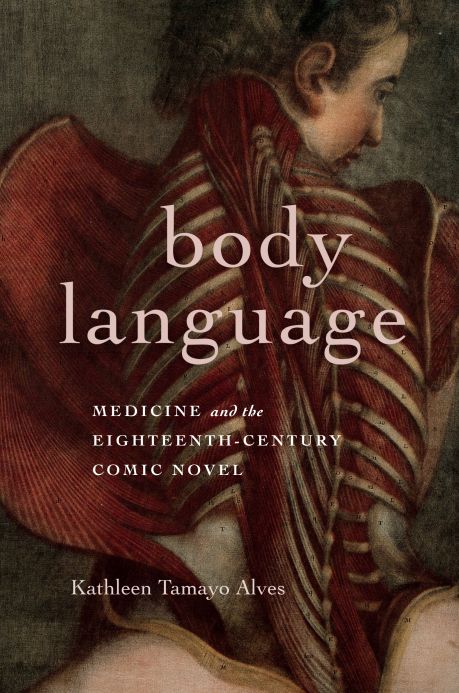
Body Language, which is part of our Transits series, explores the competing ideas espoused in medical texts and British 18th-century comic novels. By examining medical writings of the Enlightenment by John Freind, Thomas Sydenham, Albrecht von Haller, John Whytt, and William Cullen, and placing them in conversation with humor novels by Henry Fielding, Tobias Smollett, Laurence Sterne, and Charlotte Lennox, Alves suggests that comic novels dramatized medical phenomena such as hysteria, pregnancy, menstruation, and nervous disorder, ultimately denoting the female body as the site for which anxieties are problematized and overdetermined. 18th-century comic novels expose the tension between medical discourse and the broader social environment, placing the belief that women are incapable of self-regulation at odds with the need for women to be virtuous sexual figures.
We spoke with Professor Alves to learn more about female embodiment, agency, and sexuality, exploring how the book’s themes are in conversation with today’s discourse on women’s bodily rights.
BUP: In your introduction, you pose the question “what links fictional works and medical texts in the eighteenth century,” ultimately concluding that “the answer, broadly stated, is the body” (6). You go on to explain that “the body, as a tangible object that conveys meaning through reference, is inherently polysemic. This polysemy is evident in both the disparate medical understandings of the body and the stylistic variations among comic authors” (6). What sparked your interest in placing these two genres in conversation? Why are these genres best suited to discuss the paradoxical and conflicting expressions of the female body in the 18th century?
Alves: My interest in the topic began at the very end of writing my dissertation on 18th-century servant literacies; the first chapter of Body Language is drawn from the last chapter of the dissertation on Tobias Smollett’s Humphry Clinker which, as it turned out, was the strongest section. This makes sense, given my naturally silly temperament and my family background. I have always been drawn to humor—the ridiculous and the absurd—for as long as I can remember. And both of my parents are in medicine. I grew up in hospitals, laboratories, and clinics, and I was fascinated by the grotesque illustrations of viscera and diseased body parts in my family library.
Through their distinctive narrative forms, both medical discourse and comic fiction try to comprehend the human condition, and both try to “cure” their audience of bodily and social ills. What I find compelling (and absurdly funny) in reading medical texts is the mental gymnastics some male physician writers performed to justify aligning new medical or scientific knowledge with maintaining gender hierarchies. This contradiction is not new for those of us who study the “Age of Enlightenment,” right? My contribution, I hope, adds a new dimension to this body of work, that the way in which comic writers drew from contemporaneous medical ideas about women’s bodies to deploy humor actually signifies a reluctant self-awareness of the flimsiness of gender ideology.
BUP: You mention that the comic genre both diffuses and builds anxiety within readers. How did this dual-layered component affect the social reception of the comic novels during the 18th century? How do you imagine audiences would respond to these novels today?
Alves: With the exception of Smollett’s Peregrine Pickle (1751), the novels examined in my book were received well by critics and audiences. These novels flirt with subversive ideas about women’s capacities and desires, and the oppressive conditions of marriage, but these books ultimately return to the conservative status quo in their endings. Comedy’s form, affect, and boundaries can be so unpredictable and confusing that it can just as easily draw in its audience into the joke or alienate them. The short answer to this question is that, by the novel’s end, nothing really changes, and I presume there’s a kind of comfort in that for some readers.
For today’s readers, I’m sure their sensibilities would be shocked (or at least I hope they would be!) by the jokes about rape and sexual violence, and jokes at the expense of the disabled and the poor. That being said, people still find these books funny since the absurdities about women are still very much present in our culture and are still determining policies about reproductive rights.
“My contribution, I hope, adds a new dimension to this body of work, that the way in which comic writers drew from contemporaneous medical ideas about women’s bodies to deploy humor actually signifies a reluctant self-awareness of the flimsiness of gender ideology.”
BUP: In chapter two, you detail the tension between women’s private epistolary writing and the censorship of personal material published to public audiences. Despite this disciplinary practice, “print renders [the] hysterical body more visible,” (63) therefore providing medical practitioners and 18th-century men, in general, with further grounds to believe in an “inherent” difference between men and women. Do you think that the social and cultural environment today also asks women to consider what they can and cannot say? Is self-censorship in this manner still present in our contemporary society, or has the growth of new media forms removed this barrier?
Alves: There are so many ways to answer this question! Social media has changed the ways we think about bodily performance. The audience assumes that these posts or influencers give us insight into the “real” lives and thoughts of women. There are so many genres of these: Get Ready With Me (GRWM) that shows the dozens of products a woman uses in her morning routine; My 5-9 after my 9-5 as a [insert identity here] that shows how a woman spends her downtime after work; and the car story time in which a woman shares a funny/outrageous/insightful story from her driver’s seat that they think will resonate with her followers. The women behind these accounts are aware that they are on social media platforms that aim to maximize engagement and profit through customized algorithms which could (and probably does) influence their content. Perhaps not “self-censorship” in the sense that they feel restricted, but curating their content in a way that probably does not reflect their truth or their real experience to increase views, likes, and shares.
What’s more, whether a woman’s content leans left, center, or right, a quick scroll through the comment section still evidences both moral panics around women’s bodies and positive feedback for talking about perimenopause, menopause, disability, menstruation, pregnancy, birth, etc. Humor is still a major source of entertainment on social media, and there are so many feminist accounts that satirize whatever current absurdity has captured the zeitgeist.
BUP: In the Coda, where you draw a modern comparison to the 2023 film Poor Things, you mention that “women’s difference—from their blood to their nerves to their genitals—continues to be the apologia for denying women bodily and reproductive autonomy” (146-147). Do you see an evolution in the way the medical field and our current cultural climate imagine women’s futures? Do available discourses imagine alternative lifestyles for women, or are we—in the 21st century—seeing a pattern similar to what we observe in 18th century medical texts and novels?
Alves: Thankfully, the medical field has evolved enough (but not entirely) to support reproductive health and bodily autonomy. The current cultural climate under this administration has turned the clock in devastating ways for women (the overturning of Roe v. Wade, budget cuts for healthcare centers in underserved communities, for programs that focus on preventing maternal death prevention and reducing infant mortality, for research on women’s health) and for children (budget cuts for SNAP, disability services in schools, gender-affirming care, and antivax policies). Women, especially white women, have been weaponized as the high-ranking avatars for this retrograde movement (Pam Bondi, Karoline Leavitt, Kristi Noem) so there is the optics of women’s support. Ironically, white women have benefitted the most from diversity initiatives like Affirmative Action, and yet, they are the most visible as the mouthpieces and lieutenants for one of the most transparently degenerative political movements in recent history. My cynical point of view is that the joke is no longer ambiguous and power is no longer hiding behind ideologies that justify oppression and violence. It is blunt and it is so very stupid.
BUP: Body Language explores how “the representation of women’s bodies through physical, psychological, and emotional embodiment is rooted in sexed and reproductive difference and how this difference became the justification for masculine domination in all areas of life in the eighteenth century” (141). How are we seeing this scenario play out in the 21st century?
Alves: This is probably recency bias, but the murder of Renee Nicole Good by ICE Agent Jonathan Ross in Minneapolis is a tragic example of the impossibility of embodying the “right” affect in the literal face of violent power. Her last words uttered calmly to the swarm of male ICE agents encircling her car: “I’m not mad at you.” Compare this with the agent’s words after killing her: “Fucking bitch.” The demonization of Good that targeted her sex and queerness and the literal lies espoused by Vice President JD Vance and DHS Secretary Kristi Noem quickly followed the news of the murder which outraged most of the nation. It is not enough to be white or to be polite; as a queer woman protesting injustice and violence against Brown people, Good was not compliant with white supremacist patriarchy. And if we are to believe what’s been said so loudly and so insistently by those in power, she deserved to die. So, in short, it seems that women must embody an unwavering, cooperative allegiance to the dominant powers or it may cost her life.